Why Change Feels Hard and How a Coach Helps You Through It
Seventy percent of workers are actively considering a career change. But wanting a change and navigating one are two very different things.
Most people underestimate what a career transition actually involves. They expect it to feel exciting. And sometimes it does. Then the snow globe gets shaken. Everything that felt settled starts swirling. The identity you built around your role, your routine, your sense of competence; all of it is suddenly in flux.
That is not weakness. That is transition. And understanding the difference between change and transition is exactly where the work of career transition coaching begins.
Why Career Transitions Feel Different From Other Changes
The organizational psychologist William Bridges made a distinction that I come back to constantly in my work: change is situational, transition is psychological.
Change happens around you. Transition happens inside you.
You can update your resume in an afternoon. You can apply for new roles before the week is out. But the internal shift (letting go of who you were professionally, sitting with uncertainty, and finding your footing in something new) that takes time. And it rarely moves on the timeline you would prefer.
This is why so many people feel stuck even when they are doing everything right. The external steps are in motion, but the internal work has not caught up yet. Career transition coaching is designed for exactly that gap.
The Three Phases of a Career Transition
Bridges identified three phases people move through during any significant transition. In a career context, these play out in ways that are specific, predictable, and genuinely useful to understand.
Phase 1: Letting Go of What Was
Every transition starts with an ending. Even when you are the one choosing to leave, there is still something to grieve. A role you were good at. A team you trusted. A version of yourself that made sense.
This is the phase most people try to skip. But skipping it tends to backfire. The grief shows up anyway, usually as resistance, indecision, or a job search that stalls for reasons that are hard to name.
One of the most powerful things I do early in the coaching process is simply give clients permission to acknowledge what they are losing. Not to dwell — but to honor. When that happens, everything that follows moves more freely.
Phase 2: The Messy Middle
Bridges called this the Neutral Zone. It is the inbetween: the old chapter is closed but the new one has not started yet. It feels disorienting, ambiguous, and slow.
I have worked with clients who describe this phase as standing in a hallway with the lights off. They know there is a door somewhere. They just cannot find it yet.
Here is what I tell them: this is not stalling. This is the most creative and necessary part of the entire journey. The Neutral Zone is where clarity starts to form and where people begin asking the right questions. Not just "what job should I get" but "what actually matters to me in my work?" That shift is everything.
The challenge is that this phase is uncomfortable enough that most people try to rush through it. Career transition coaching helps you stay with it long enough for it to do its work.
Phase 3: Moving Into What Is Next
New beginnings do not arrive on a schedule. They tend to emerge. One day the fog is a little lighter. The direction feels a little clearer. A role description actually excites you.
A new beginning is not just a start date. It is the internal moment when you can say with confidence: I can see myself in this. That shift in identity, from who you were to who you are becoming, is what career transition coaching is ultimately supporting.
The Emotional Wave You Are Probably Riding
Alongside the structural phases, there is an emotional dimension to career transitions that is worth naming directly.
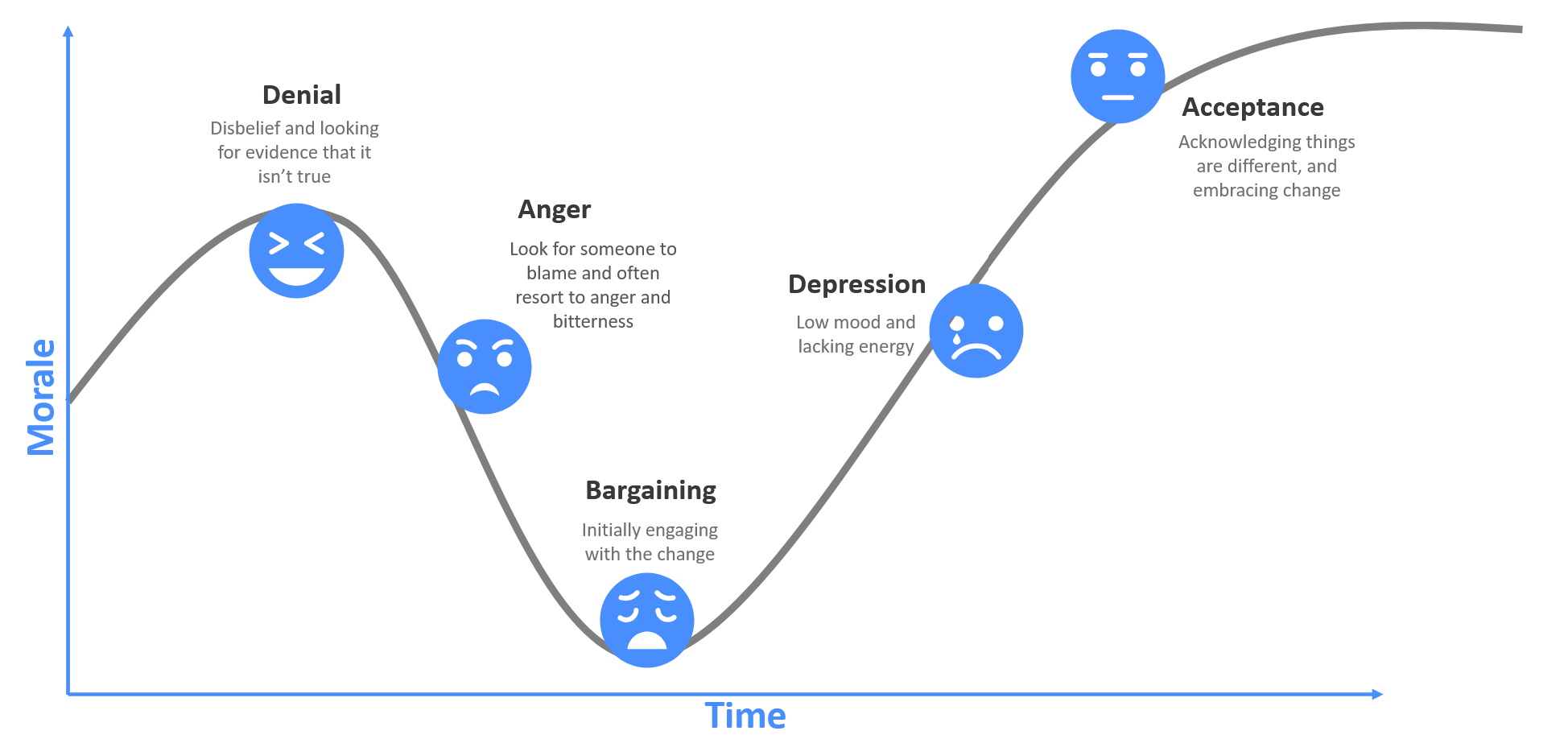
The Kübler-Ross model, originally developed to describe the stages of grief, has become one of the most useful frameworks for understanding the emotional arc of any major change. In a career context, it typically looks something like this:
Shock: "Wait — this is really happening."
Denial: "It will probably work itself out."
Anger or Frustration: "Why is this so hard? I should be further along."
Bargaining: "Maybe if I just update my resume one more time…"
Sadness: "I don't know who I am without this work."
Acceptance: "Okay. I can start to see a path forward."
Integration: "This is who I am now. And I am okay with that."
Not everyone moves through these in order. Some cycle back. Some camp out in one stage for months. What matters is that these responses are normal and that having someone to help you name them and move through them makes a real difference.
Where Career Transition Coaching Comes In
Here is what often surprises people: career transition coaching is not just about tactics.
Yes, I help clients with resumes, LinkedIn, interview preparation, and job search strategy. That is real, tangible work and you can explore those services here. But the tactical work only lands when the internal work is also happening. A strong resume does not help much if you are still grieving a role you loved, or applying for jobs that do not actually reflect what you want. Coaching addresses both layers at once.
I worked with a client who came to me after a layoff. She had been in her industry for fifteen years: sharp, capable, but also completely lost. She was deep in the Neutral Zone: she knew she did not want to go back to what she had been doing, but she had not yet given herself permission to want something different. We spent the first two sessions not on her resume at all, but on what she was actually grieving and what she genuinely wanted. By session three, she had more clarity than she had experienced in years. The job search that followed was focused, intentional, and relatively fast.
That is what coaching does. It makes the whole process more efficient. Not by rushing it, but by doing the right work in the right order.
My approach is strengths based and person centered, which means we build your job search around what you are genuinely good at and what actually motivates you. You can learn more about the coaching process here.
What to Expect From Working With a Career Coach
A well-executed career pivot typically takes four to eight months. That timeline depends on your situation, your goals, and how much support you want. Some clients come to me at the very beginning of a transition, when they are not even sure what they want. Others arrive with a clear direction and need focused support to execute it.
Here is what working together looks like:
Clarity first. We start by understanding where you are and what you want through conversation, assessments, and goal alignment.
A personalized strategy. Not a generic checklist. An actual plan built around your strengths, your industry, and your goals.
Execution support. Resume refinement, LinkedIn optimization, networking guidance, and interview preparation. All grounded in who you are and where you are going.
Research shows that 80% of career changers report being happier in their new role than in their previous one. That outcome is not accidental. It comes from doing the work thoughtfully and from having support through the parts that feel hard.
Frequently Asked Questions
What is career transition coaching?
Career transition coaching is a structured, one on one process that helps you navigate the emotional and practical sides of changing careers or roles. A coach helps you gain clarity on your goals, understand your strengths, and build a concrete strategy for your next move. It is forward focused and oriented toward action and outcomes.
How long does career transition coaching take?
Most career transitions take four to eight months when well supported. The length of a coaching engagement depends on your specific situation and goals, but most clients work across multiple sessions to move through the full arc from clarity to offer.
Is career transition coaching worth it?
Research shows that 80% of career changers report being happier after making the switch. Coaching helps you get there with more focus, less wasted time, and greater confidence, which leads to better outcomes, faster.
How is a career coach different from a recruiter?
A recruiter is hired by companies to fill roles. A career coach works for you. The goal is to help you figure out what you want, position yourself effectively, and navigate the process on your own terms.
Who is career transition coaching right for?
Career transition coaching is a strong fit if you are feeling stuck, burned out, or unsure of your next step. It is also valuable if you know where you want to go but need support getting there, through a stronger resume, clearer messaging, or a more focused job search strategy.
Your Gratifying Career Starts Here!
If you are in the middle of a transition or feeling the pull toward one, I would love to talk. Let’s figure out what your next step looks like together.
